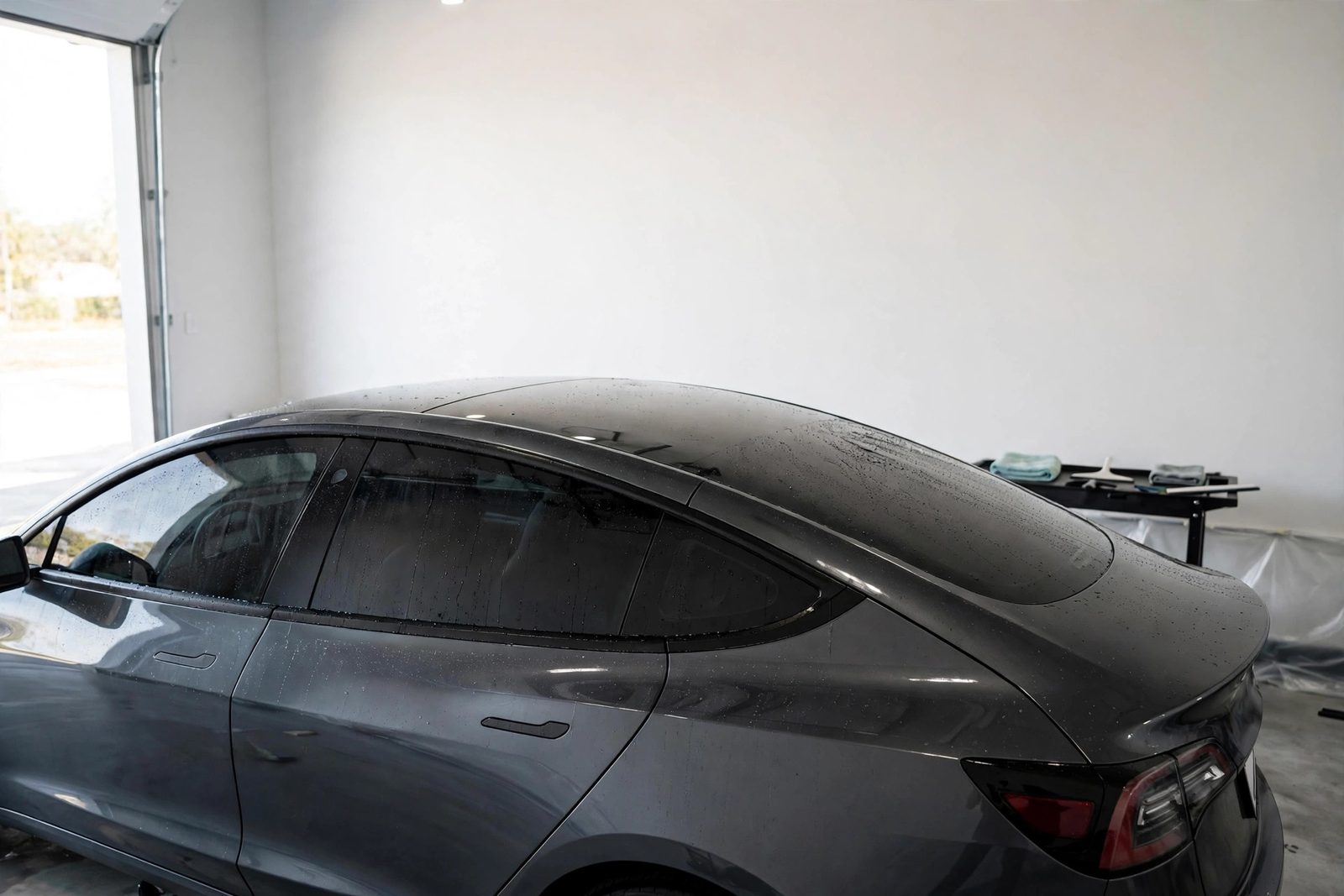
Wondering how long does window tint take to cure in Georgia humidity? Plan on 2–4 weeks for a full cure on car windows in summer — longer in muggy or cool stretches — and up to 30 days for home film. The haze and water pockets you see in week one are the cure working, not failing.
What window tint cure time in Snellville GA actually means
Film is installed wet: a mounting solution lets the installer position it, then the adhesive bonds as that moisture evaporates out through the film itself. Until the last of it leaves, the bond is not at full strength.
That in-between state is the cure window. The film looks finished from the street, but up close you may see milkiness, streaks, or small pockets of water — all normal, all temporary on a sound install.
Cure time is not install time. Most cars leave our Snellville shop the same day; the calendar below is what happens afterward in your driveway. Aftercare for any install is on our car window tinting page.
How long does window tint take to cure in Snellville humidity?
Dry-to-the-touch takes days; full cure takes weeks. Sun and warmth are your allies — a car parked outside in July cures markedly faster than one garaged through a rainy spell.
Realistic Snellville timelines:
- Safe to drive: immediately — the film is set in place
- Roll windows down: wait 3–5 days, no exceptions in week one
- Haze and water pockets clear: typically 3–14 days in summer
- Full cure, car film: about 2–4 weeks; home film up to 30 days
If anything still looks wrong after 30 days — bubbles that grew, lifted edges, gritty spots — that is no longer curing. That is a warranty conversation, and on our installs it is a free one.
Why Snellville humidity slows the cure
Evaporation needs somewhere for the moisture to go. When the air is already saturated, moisture escapes through the film slowly, a little each day, instead of clearing in a dry weekend.
Three local facts stack the deck:
- Summer humidity keeps overnight air damp, so curing barely advances after dark
- Air-conditioned cabins and garages stay cool — and cool glass cures slowly
- Thick ceramic and flagship films pass moisture more slowly than thin dyed film
None of this harms the film. It only stretches the calendar — which is why the same job cures in ten days in a dry September and three weeks in a swampy July.
Cure times by film type and season
Thicker, higher-tech films hold more mounting solution and cure slowest — plan accordingly:
By film type
- Dyed film: fastest cure, roughly 1–3 weeks
- Carbon film: about 2–3 weeks
- Ceramic film: about 2–4 weeks
- Home solar and safety films: up to 30 days, large panes longest
These are calendars for appearance and full bond strength, not driving restrictions — only the roll-down rule and gentle handling apply day to day.
By season in Snellville
Summer installs cure fastest despite humidity because heat wins; winter installs can take the longest even in drier air, because cold glass holds moisture. Spring and fall land in between.
Parking in the sun is the one free accelerant: an afternoon of solar warmth does more for a cure than any product. Never apply a heat gun or hair dryer yourself — uneven heat blisters film.
What you can and cannot do during the cure window
The rules are few and simple. The roll-down rule is the one that actually damages film when broken; the rest protect edges and adhesive while they set.
Safe during the cure:
- Drive normally, including highway speeds and rain
- Wash the car’s exterior as usual
- Use AC, heat, and the rear defroster normally
- Park in direct sun — it speeds the cure
Avoid during the cure:
- Rolling windows down for the first 3–5 days
- Cleaning the inside glass for about a week
- Picking, pressing, or squeegeeing bubbles yourself
- Seat-belt buckles and rings striking fresh edges
When the week passes, our guide to cleaning tint without scratching it covers the ammonia-free routine to use from then on.
Common mistakes that extend cure time
Rolling a window down on day two is the champion: the glass drags through the door seal and can peel or crease the film’s lower edge before the adhesive sets.
Cleaning too early is second — wiping shifts uncured film microscopically and works moisture back under edges, resetting the clock in that area.
Trying to “help” bubbles with a pin, a card, or a fingernail converts a temporary water pocket into a permanent scar. Water leaves on its own; holes do not heal.
Parking in a cold garage for two weeks slows everything; if the calendar matters, give the car sun time during the day.
Finally, judging the job on day three. Clarity arrives progressively, edges last. A film that looks 90% right in week one is usually a film finishing normally.
Our ceramic tint installs carry the same cure guidance in writing, so nobody has to remember a verbal version of this list.
When to call a professional
Call when you see any of these instead of normal cure signs:
- Edges lifting, curling, or catching on the door seal
- Bubbles that grow after the second week
- Gritty or sandy spots that never change
- A crease, fold, or fingernail mark in the film
- Anything unchanged after 30 days
At O2 Window Tinting, 3304 Stone Mountain Hwy, Snellville, we would rather look at a normal cure for free than have you worry — or poke at it — for a month. Rated 4.9 stars across 603 Google reviews.
Open Monday–Friday 9 AM–6 PM, Saturday 9 AM–5 PM, closed Sunday. Call (770) 674-2766 and describe what you are seeing; we will tell you if it needs a visit.
Frequently Asked Questions
How long does window tint take to cure in Snellville GA?
Plan on 2–4 weeks for a full cure in summer, longer in humid or cool stretches. The film is safe to drive with immediately, but moisture haze and small water pockets can take days to weeks to evaporate through the film. Home film can take up to 30 days.
How long before I can roll my windows down after tint?
Wait 3–5 days. Rolling a window down too early can drag and peel the film's edge at the seal while the adhesive is still setting. If you forget once, do not panic — raise it gently and check the edge; call us if anything lifted.
Does humidity really slow down tint curing?
Yes. Curing is evaporation: mounting moisture must escape through the film. Humid Snellville air is already near saturation, so moisture leaves slowly — which is why the same film cures faster in a dry week than in a muggy one.
Can I wash my car after getting tint?
Wash the outside whenever you like — film is on the inside. Wait about a week before cleaning the inside glass, then use only ammonia-free cleaner and microfiber. Avoid car-wash brushes or anything abrasive near fresh edges during the cure window.
Is it normal for new tint to look hazy or bubbly?
Yes, within limits. Haziness, streaks, and small water pockets are trapped mounting solution finishing its exit and usually clear as the cure completes. Bubbles that grow, edges that lift, or contamination spots are different — those are worth a call.
Get help with window tinting in Snellville
Fresh install from us? Your cure guidance is on your paperwork. Shopping for one? See car window tinting or call O2 Window Tinting at (770) 674-2766 before your install day arrives.
And if your “cure bubbles” are on house glass, our post on home tint bubbles covers the residential version of this timeline.